Showing posts with label ancient science. Show all posts

Thursday, July 10, 2008

Baghdad Battery


History

In 1936, while excavating ruins of a 2000-year-old village near Baghdad, workers discovered mysterious small vase. A 6-inch-high pot of bright yellow clay dating back two millennia contained a cylinder of sheet-copper 5 inches by 1.5 inches. The edge of the copper cylinder was soldered with a 60-40 lead-tin alloy comparable to today's solder. The bottom of the cylinder was capped with a crimped-in copper disk and sealed with bitumen or asphalt. Another insulating layer of asphalt sealed the top and also held in place an iron rod suspended into the center of the copper cylinder. The rod showed evidence of having been corroded with an acidic agent.

Get the educational background to do your own mystery sleuthing with an accredited online degree. Online engineering degrees will let you understand the science that underlies many strange discoveries.

An Ancient Battery

More...


German archaeologist , Wilhelm Konig, examined the object and came to a surprising conclusion that the clay pot was nothing less than an ancient electric battery.


The ancient battery in the Baghdad Museum

The ancient battery in the Baghdad Museum, as well as those others which were unearthed in Iraq, are all dated from the Parthian occupation between 248 BCE and 226 CE. However, Dr. Konig also found copper vases plated with silver in the Baghdad Museum, excavated from Sumerian sites in southern Iraq, dating back to at least 2500 BCE. When the vases were lightly tapped, a blue patina or film separated from the surface, which is characteristic of silver electroplated onto copper base. It would appear then that the Parthians inherited their batteries from one of the earliest known civilizations.


In 1940, Willard F.M. Gray, an engineer at the General Electric High Volatage Laboratory in Pittsfield, Massachusetts, read of Konig's theory. Using drawings and details supplied by German rocket scientist Willy Ley, Gray made a replica of the battery. Using copper sulfate solution, it generated about half a volt of electricity.

In 1970s, German Egyptologist, Arne Eggebrecht built a replica of the Baghdad battery and filled it with freshly pressed grape juice, as he speculated the
ancients might have done. The replica generated 0.87V. He used current from the battery to electroplate a silver statuette with gold.

This experiment proved that electric batteries were used some 1,800 years before their modern invention by Alessandro Volta in 1799.
It also seems that the use of similar batteries can be safely placed into ancient Egypt, where several objects with traces of electroplated precious metals have been found at different locations. There are several anomalous finds from other regions, which suggests use of electricity on a grander scale.

The Riddle of "Baghdad's batteries"


Arran Frood investigates what could have been the very first batteries and how these important archaeological and technological artefacts are now at risk from the impending war in Iraq.

I don't think anyone can say for sure what they were used for, but they may have been batteries because they do work Dr Marjorie Senechal


War can destroy more than a people, an army or a leader. Culture, tradition and history also lie in the firing line.
Iraq has a rich national heritage. The Garden of Eden and the Tower of Babel are said to have been sited in this ancient land.

In any war, there is a chance that priceless treasures will be lost forever, articles such as the "ancient battery" that resides defenceless in the museum of Baghdad.

For this object suggests that the region, whose civilizations gave us writing and the wheel, may also have invented electric cells - two thousand years before such devices were well known.


Biblical clues

It was in 1938, while working in Khujut Rabu, just outside Baghdad in modern day Iraq, that German archaeologist Wilhelm Konig unearthed a five-inch-long (13 cm) clay jar containing a copper cylinder that encased an iron rod.

THE KEY COMPONENTS
Batteries dated to around 200 BC Could have been used in gilding


The vessel showed signs of corrosion, and early tests revealed that an acidic agent, such as vinegar or wine had been present.
In the early 1900s, many European archaeologists were excavating ancient Mesopotamian sites, looking for evidence of Biblical tales like the Tree of Knowledge and Noah's flood.

Konig did not waste his time finding alternative explanations for his discovery. To him, it had to have been a battery.

Though this was hard to explain, and did not sit comfortably with the religious ideology of the time, he published his conclusions. But soon the world was at war, and his discovery was forgotten.


Scientific awareness

More than 60 years after their discovery, the batteries of Baghdad - as there are perhaps a dozen of them - are shrouded in myth.

"The batteries have always attracted interest as curios," says Dr Paul Craddock, a metallurgy expert of the ancient Near East from the British Museum.

"They are a one-off. As far as we know, nobody else has found anything like these. They are odd things; they are one of life's enigmas."

No two accounts of them are the same. Some say the batteries were excavated, others that Konig found them in the basement of the Baghdad Museum when he took over as director. There is no definite figure on how many have been found, and their age is disputed.

Most sources date the batteries to around 200 BC - in the Parthian era, circa 250 BC to AD 225. Skilled warriors, the Parthians were not noted for their scientific achievements.

"Although this collection of objects is usually dated as Parthian, the grounds for this are unclear," says Dr St John Simpson, also from the department of the ancient Near East at the British Museum.

"The pot itself is Sassanian. This discrepancy presumably lies either in a misidentification of the age of the ceramic vessel, or the site at which they were found."


Underlying principles

In the history of the Middle East, the Sassanian period (circa AD 225 - 640) marks the end of the ancient and the beginning of the more scientific medieval era.

Though most archaeologists agree the devices were batteries, there is much conjecture as to how they could have been discovered, and what they were used for.

How could ancient Persian science have grasped the principles of electricity and arrived at this knowledge?

Perhaps they did not. Many inventions are conceived before the underlying principles are properly understood.

The Chinese invented gunpowder long before the principles of combustion were deduced, and the rediscovery of old herbal medicines is now a common occurrence.

You do not always have to understand why something works - just that it does.

Enough zap

It is certain the Baghdad batteries could conduct an electric current because many replicas have been made, including by students of ancient history under the direction of Dr Marjorie Senechal, professor of the history of science and technology, Smith College, US.

"I don't think anyone can say for sure what they were used for, but they may have been batteries because they do work," she says. Replicas can produce voltages from 0.8 to nearly two volts.

Making an electric current requires two metals with different electro potentials and an ion carrying solution, known as an electrolyte, to ferry the electrons between them.
Connected in series, a set of batteries could theoretically produce a much higher voltage, though no wires have ever been found that would prove this had been the case.

"It's a pity we have not found any wires," says Dr Craddock. "It means our interpretation of them could be completely wrong."

But he is sure the objects are batteries and that there could be more of them to discover. "Other examples may exist that lie in museums elsewhere unrecognised".

He says this is especially possible if any items are missing, as the objects only look like batteries when all the pieces are in place.


Possible uses

Some have suggested the batteries may have been used medicinally.

The ancient Greeks wrote of the pain killing effect of electric fish when applied to the soles of the feet.

The Chinese had developed acupuncture by this time, and still use acupuncture combined with an electric current. This may explain the presence of needle-like objects found with some of the batteries.

But this tiny voltage would surely have been ineffective against real pain, considering the well-recorded use of other painkillers in the ancient world like cannabis, opium and wine.

Other scientists believe the batteries were used for electroplating - transferring a thin layer of metal on to another metal surface - a technique still used today and a common classroom experiment.

This idea is appealing because at its core lies the mother of many inventions: money.

In the making of jewellery, for example, a layer of gold or silver is often applied to enhance its beauty in a process called gilding.


Grape electrolyte

Two main techniques of gilding were used at the time and are still in use today: hammering the precious metal into thin strips using brute force, or mixing it with a mercury base which is then pasted over the article.

These techniques are effective, but wasteful compared with the addition of a small but consistent layer of metal by electro-deposition. The ability to mysteriously electroplate gold or silver on to such objects would not only save precious resources and money, but could also win you important friends at court.
Let's hope the world manages to resolve its present problems so people can go and see them. Dr Paul Craddock


A palace, kingdom, or even the sultan's daughter may have been the reward for such knowledge - and motivation to keep it secret.
Testing this idea in the late seventies, Dr Arne Eggebrecht, then director of Roemer and Pelizaeus Museum in Hildesheim, connected many replica Baghdad batteries together using grape juice as an electrolyte, and claimed to have deposited a thin layer of silver on to another surface, just one ten thousandth of a millimetre thick.

Other researchers though, have disputed these results and have been unable to replicate them.

"There does not exist any written documentation of the experiments which took place here in 1978," says Dr Bettina Schmitz, currently a researcher based at the same Roemer and Pelizaeus Museum.

"The experiments weren't even documented by photos, which really is a pity," she says. "I have searched through the archives of this museum and I talked to everyone involved in 1978 with no results."


Tingling idols

Although a larger voltage can be obtained by connecting more than one battery together, it is the ampage which is the real limiting factor, and many doubt whether a high enough power could ever have been obtained, even from tens of Baghdad batteries.

One serious flaw with the electroplating hypothesis is the lack of items from this place and time that have been treated in this way.

"The examples we see from this region and era are conventional gild plating and mercury gilding," says Dr Craddock. "There's never been any untouchable evidence to support the electroplating theory."

He suggests a cluster of the batteries, connected in parallel, may have been hidden inside a metal statue or idol.

He thinks that anyone touching this statue may have received a tiny but noticeable electric shock, something akin to the static discharge that can infect offices, equipment and children's parties.

"I have always suspected you would get tricks done in the temple," says Dr Craddock. "The statue of a god could be wired up and then the priest would ask you questions.

"If you gave the wrong answer, you'd touch the statue and would get a minor shock along with perhaps a small mysterious blue flash of light. Get the answer right, and the trickster or priest could disconnect the batteries and no shock would arrive - the person would then be convinced of the power of the statue, priest and the religion."


Magical rituals

It is said that to the uninitiated, science cannot be distinguished from magic. "In Egypt we know this sort of thing happened with Hero's engine," Dr Craddock says.

Hero's engine was a primitive steam-driven machine, and like the battery of Baghdad, no one is quite sure what it was used for, but are convinced it could work.

If this idol could be found, it would be strong evidence to support the new theory. With the batteries inside, was this object once revered, like the Oracle of Delphi in Greece, and "charged" with godly powers?

Even if the current were insufficient to provide a genuine shock, it may have felt warm, a bizarre tingle to the touch of the unsuspecting finger.

At the very least, it could have just been the container of these articles, to keep their secret safe.

Perhaps it is too early to say the battery has been convincingly demonstrated to be part of a magical ritual. Further examination, including accurate dating, of the batteries' components are needed to really answer this mystery.

No one knows if such an idol or statue that could have hidden the batteries really exists, but perhaps the opportunity to look is not too far away - if the items survive the looming war in the Middle East.

"These objects belong to the successors of the people who made them," says Dr Craddock. "Let's hope the world manages to resolve its present problems so people can go and see them."

Ancient Flying Machines


Introduction

Flight has been the dream of humankind since they watched in awe as birds soared effortlessly through the sky. But, according to accepted history, it wasn't until the 1780s that two Frenchmen achieved lighter-than-air flight when they were lifted into the air in a hot air balloon near Paris. Then powered, heavier-than-air flight became the goal. And although it was theorized that heavier-than-air flight was possible as early as the 13th century, and in the 16th century Leonardo da Vinci designed winged aircraft and a crude kind of helicopter, it wasn't until the Wright brothers made their first successful flights at Kitty Hawk in 1903 that powered flight became a reality.

More...

That's the widely accepted history. Some researchers and a few rogue scientists believe there's evidence to suggest that humans achieved flight earlier in history - much earlier... so early, they say, that the knowledge of this technology has been lost and ancient stories that recount adventures of human flight have been relegated only to myth.

Is it possible that humans developed the technology to fly in early civilizations - or in civilizations that are now lost to history? Let's take a look at what some call the evidence - intriguing artifacts, carvings, inscriptions and legends - that they say point to the true record human of flight.

Precolombian Airplane Models

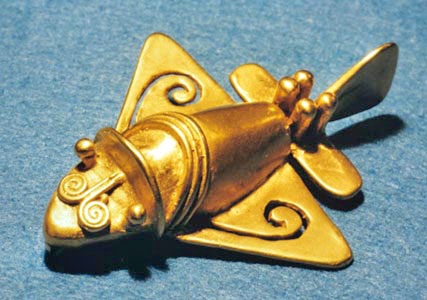
Is the concept of an airplane limited to Egypt? That doesn't seem to be the case. Gold trinkets were found in an area covering Central America and coastal areas of South America, estimated to belong to a period between 500 and 800 CE, but since they are made from gold, accurate dating is impossible and based essentially on stratigraphy which may be deceptive. However, we can safely say that these gold objects are more than 1000 years old.


Whatever this object is supposed to be or represent,
its remarkable resemblance to a modern aircraft or spacecraft is uncanny.

As seen from the pictures, the shape of the sample object is rather ambiguous. The archaeologists labelled these objects as zoomorphic, meaning, animal shaped objects. The question is, what animal do they represent? When we compare these with other objects from the same cultures depicting animals, a curious facet of the comparison would be obvious: the other objects are recognizable, rendered usually with a great accuracy and attention to realistic detail.


There are several types of animals which fly—birds, insects, and several mammals, such as bats and some gliders, for instance flying squirrels, oppossums, and then there are some lizards; there are also some fish which for brief periods glide through the air. There are water animals which seem to fly through the water, such as rays, skates and some selachians. But how does the depicted object compare with these choices? All its features taken into a consideration, we have no match. Seen from above, the object obviously has no fish features, but seems to show rather explicitly mechanistic ones.

The structures just in front of the tail are strongly reminiscent of elevons (a combination of ailerons and elevators) with a slight forward curve, but they are attached to the fuselage, rather than the wings. In any case, they look more like airplane parts than like the claspers of a fish. If the two prominent spirals on the wings are supposed to be a stylized version of the eyes of a ray, then what are the two globular objects positioned on the head supposed to represent? To complicate the identification even more, the spirals on the wings have their copies positioned on the nose of the object, in the opposite direction. When the object is viewed in profile, the didsimilarity to anything from the animal kingdom is even more pronounced. If the zoomorphic explanation is supposed to hold, then why did the artist cut the head off almost three quarters from the body? And why is the nose is practically rectangular and the cut tilted forward, with eyes positioned at either side, when fish eyes are usually more near the center of bodyline and far forward on the head?

What we can make of the semicircular grooves on the inside of the cut? What is it supposed to be—fishwise? And what about the scoop, forward and under the cut? It is a scoop, not just a ridge for drilling a hole through to place the object on a necklace chain. Then there is another rectangular feature, positioned further back at the approximate center of gravity under the fuselage. The wings when viewed from the side are perfetly horizontal, but when seen from the front, they curve slightly downward. The elevators, which are right behind the wings, are positioned on a slightly higher horizontal level and are square-ended, thus a definite geometric shape. Above them is another rectangular shape, with a relief which may be reminiscent of knobs. The tail is equally intriguing. No fish has only a single, upright and perpendicular flange. But this tail fin has an exact shape of fins on modern airplanes. There are also some markings on the tail which are hard to identify, but it does not seem to be anything related to animals, either.

When all the features are taken into an account, the object does not look like a representation of any known animal at all, but does look astonishingly like an airplane. The photos and enlarged outline of the object has been submitted for an analysis to several people from the field of aerodynamics. One of them was Arthur Young, a designer of Bell helicopters and other aircraft. His analysis confirmed that the object contains many features which would fit the airplane hypothesis, but there were several ones which would not fit that scenario. Wings do seem to be in the wrong place—they should be further forward so that their 1/4-chord coincides with the center of gravity. The nose is not like anything on airplanes, as well. So, while the object is suggesting an airplane, some features would not seem to support this hypothesis.

But let's entertain several possibilities. If we imagine that the separation after the windshield is not a cockpit and that the pilot and the cargo were located somewhere in the main fuselage body, then we can envision the nose as something else. Let's assume that the nose is actually a jet. If the machine needs to slow down, the jet flow directed against the path of flight would accomplish just that. But how to redirect the jet into the opposite direction? If we envision the nose as a movable part of the plane, turning around the point located where the nose and fuselage meet, thus pivoting the nose downward to tuck it under the fuselage, that would enable the desired effect. What's more, it will re-adjust the center of gravity and the wings would be just in the right place for a high powered flight. Another problem, though, will appear and that is the drag which would be created by the back of the nose now positioned in front. But that can be attributed to artistic license. That seems to be the case, because several other similar planes feature the back part of the nose tilted more forward, so the angle of the back of the nose when pivoted is more corresponding to aerodynamic principles.

All things considered, the object seems to represent a convertible type of craft, with two possible configurations—one for ascent when the nose is facing backwards, and the other for descent with the nose facing forward. One unsolved item remains—the spirals on the both wings and the nose. According to Amerindian iconography, these spirals have discernable meaning—they represent ascending and descending, depending on whether they are right-oriented or left-oriented, respectively. As the spirals are not only on wings but also on the nose, the meaning is fairly obvious—the wings and the nose (as much) were the features which were directly involved in ascent and descent.

There are other cultures which mention flying vehicles of some sort or another. The most known of these sources are Indian epics, especially the Mahábhárata and other Védic sources as Bhágavata Purána and Rámáyana. The flying devices were called vimánas and were extensively discussed in Vaimánika Shástra, describing multitude of machines with different purposes and capabilities.

Other source of information about flying machines may be considered, such as the Bible and some apocryphal works. The book of Ezekiel seems to be describing the close encounter of a man from a non-technological culture with a device which to him must have been miraculous. We have to put ourselves into his shoes to comprehend his astonishment and the otherworldness of his encounter. The limited scope of knowledge of the world around him, his primitive environment, dictated the language and conceptual framework with which he tried to capture his encounter for fellow tribesmen. For him it seemed that he encountered The God, with his suite of angels, because in his simple world, there was no other interpretation. It is not necessary to reach for an alien type of scenario to explain the encounter; we can entertain a possibility that a remnant of an advanced civilization was still present, in a limited scope, at the time of Ezekiel. But for some, the encounter bears uncanny similarity to the modern-day encounters with UFO's. Another source of similar material is the Book of Enoch, particularly the Slavic version, which contains some parts which the Greek version is missing. The book not only describes flying in the air, but also through outer space, including the relativistic effects mentioned—Enoch spent several days on a spacecraft, but when he returned to Earth, several centuries had passed by.

There is no shortage of descriptions of flying machines in ancient sources. If we try to extract the core of myths of different provenience and remove the embellishments, we discover to our surprise that flying in ancient times seems to be the rule, not the exception.

Wednesday, July 9, 2008

Antikythera Mechanism


An Ancient Greek Computer? - Part 1

In 1901 divers working off the isle of Antikythera found the remains of a clocklike mechanism 2,000 years old. The mechanism now appears to have been a device for calculating the motions of stars and planets by Derek J. de Solla Price

Among the treasures of the Greek National Archaeological Museum in Athens are the remains of the most complex scientific object that has been preserved from antiquity. Corroded and crumbling from 2,000 years under the sea, its dials, gear wheels and inscribed plates present the historian with a tantalizing problem. Because of them we may have to revise many of our estimates of Greek science. By studying them we may find vital clues to the true origins of that high scientific technology which hitherto has seemed peculiar to our modern civilization, setting it apart from all cultures of the past.

More...

From the evidence of the fragments one can get a good idea of the appearance of the original object. Consisting of a box with dials on the outside and a very complex assembly of gear wheels mounted within, it must have resembled a well- made 18ih-century clock. Doors hinged to the box served to protect the dials, and on all available surfaces of box, doors and dials there were long Greek inscriptions describing the operation and construction of the instrument. At least 20 gear wheels of the mechanism have been preserved, including a very sophisticated assembly of gears that were mounted eccentrically on a turntable and probably functioned as a sort of epicyclic or differential, gear-system.

Nothing like this instrument is preserved elsewhere. Nothing comparable to it is known. from any ancient scientific text or literary allusion. On the contrary, from all that we know of science and technology in the Hellenistic Age we should have felt that such a device could not exist. Some historians have suggested that the Greeks were not interested in experiment because of a contempt-perhaps induced by the existence of the institution of slavery-for manual labor. On the other hand it has long been recognized that in abstract mathematics and in mathematical astronomy they were no beginners but rather "fellows of another college" who reached great heights of sophistication. Many of the Greek scientific devices known to us from written descriptions show much mathematical ingenuity, but in all cases the purely mechanical part of the design seems relatively crude. Gearing was clearly known to the Greeks, but it was used only in relatively simple applications. They employed pairs of gears to change angular speed or mechanical ad- vantage, or to apply power through a right angle, as in the water-driven mill.

Even the most complex mechanical devices described by the ancient writers Hero of Alexandria and Vitruvius contained only simple gearing. For example, the taximeter used by the Greeks to measure the distance travelled by the wheels of a carriage employed only pairs of gears (or gears and worms) to achieve the necessary ratio of movement. It could be argued that if the Greeks knew the principle of gearing, they should have had no difficulty in constructing mechanisms as complex as epicyclic gears. We now know from the fragments in the National Museum that the Greeks did make such mechanisms, but the knowledge is so unexpected that some scholars at first thought that the fragments must belong to some more modern device.

Can we in fact be sure that the device is ancient? If we can, what was its purpose? What can it tell us of the ancient world and of the evolution of modern science? To authenticate the dating of the fragments We must. tell the story of their discovery, which involves the first (though inadvertent) adventure in underwater archaeology. Just before Easter in 1900 a party of Dodecanese sponge-divers were driven by storm to anchor near the tiny southern Greek island of Antikythera (the accent is on the "kyth," pronounced to rhyme with pith). There, at a depth of some 200 feet, they found the wreck of an ancient ship. With the help of Greek archaeologists the wreck was explored; several fine bronze and marble statues and other objects were recovered. The finds created great excitement, but the difficulties of diving without heavy equipment were immense, and in September, 1901, the "dig' was abandoned. Eight months later Valerios StaÎs, an archaeologist at the National Museum, was examining some calcified lumps of corroded bronze that had been set aside as possible pieces of broken statuary. Suddenly he recognized among them the fragments of a mechanism.

It is now accepted that the wreck occurred during the first century B.C. Gladys Weinberg of Athens has been kind enough to report to me the results of several recent archaeological examinations of the amphorae, pottery and minor objects from the ship. It appears from her report that one might reason-ably date the wreck more closely as 65 B.C. ±15 years. Furthermore, since the identifiable objects come from Rhodes and Cos, it seems that the ship may have. been voyaging from these islands to Rome, perhaps without calling at the Greek mainland.
The fragment that first caught the eye of StaÎs was one of the corroded, inscribed plates that is an integral part of the Antikythera mechanism, as the device later came to be called. StaÎs saw immediately that the inscription was ancient. In the opinion of the epigrapher Benjamin Dean Meritt, the forms of the letters are those of the 'first century B.C.; they could hardly be older than 100 B.C. nor younger than the time of Christ. The dating is supported by the content of the inscriptions. The words used and their astronomical sense are all of this period. For example, the most extensive and complete piece of inscription is part of a parapegma (astronomical calendar) similar to that written by one Geminos, who is thought to have lived in Rhodes about 77 B.C. We may thus be reasonably sure that the mechanism did not find its way into the wreck at some later period. Furthermore, it cannot have been very old when it was taken aboard the ship as booty or merchandise.

As soon as the fragments had been discovered they were examined by every available archaeologist; so began the long and difficult process of identifying the mechanism and determining its function. Some things were clear from the beginning. The unique importance of the object was obvious, and the gearing was impressively complex. From the inscriptions and the dials the mechanism was correctly identified as an astronomical device. The first conjecture was that it was some kind of navigating instrument – perhaps an astrolabe (a sort of circular star-finder map also used for simple observations). Some thought that it might be a small planetarium of the kind that Archirnedes is said to have made. Unfortunately the fragments were covered by a thick curtain of calcified material and corrosion products, and these concealed so much detail that no one could be sure of his conjectures or reconstructions. There was nothing to do but wait for the slow and delicate work of the Museum technicians in cleaning away this curtain. Meantime, as the work proceeded, several scholars published accounts of all that was visible, and through their labors a general picture of the mechanism began to emerge. On the basis of new photographs made for me by the Museum in 1955 I realized that the work of cleaning had reached a point where it might at last be possible to take the work of identification to a new level. Last summer, wilt the assistance of a grant from the American Philosophical Society, I was able to visit Athens and make a minute examination of the fragments. By good fortune George Stamires, a Greek epigrapher, was there at the same time; he was able to give me invaluable help by deciphering and transcribing much more of the inscriptions than had been read before. We are now in the position of being able to "join" the fragments and to see how they fitted together in the original machine and when they were brought up from the sea [see illustration]. The success of this work has been most significant, for previously it had been supposed that the various dials and plates had been badly squashed together and distorted. It now appears that most of the pieces are very nearly in their original places, and that we have a much larger fraction of the complete device than had been thought. This work also provides a clue to the puzzle of why the fragments lay unrecognized until StaÎs saw them. When they were found, the fragments were probably held together in their original positions by the remains of the wooden frame of the case. In the Museum the waterlogged wood dried and shriveled. The fragments then fell apart, revealing the interior of the mechanism, with its gears and inscribed plates. As a result of the new examinations we shall in due course be able to publish a technical account of the fragments and of the construction of the instrument. In the meantime we can tentatively summarize some of these results and show how they help to answer the question. What is it? There are four ways of getting at the answer First, if we knew the details of the mechanism, we should know what it did. Second, if we could read the dials, we could tell what they showed. Third, if we could understand the inscriptions, they might tell us about the mechanism. Fourth, if we knew of any similar mechanism, analogies might be helpful. All these approaches must be used, for none of them is complete.

The geared wheels within the mechanism were mounted on a bronze plate. On one side of the plate we can trace all the gear wheels of the assembly and can determine, at least approximately, how many teeth each had and how they meshed together. On the other side we can do nearly as well, but we still lack vital links that would provide a complete picture of the gearing. The general pattern of the mechanism is nonetheless quite clear. An input was provided by an axle that came through the side of the casing and turned a crown-gear wheel. This moved a big, four-spoked driving-wheel that was connected with two trains of gears that respectively led up and down the plate and were connected by axles to gears on the other side of the plate. On that side the gear-trains continued, leading through an epicyclic turntable and coming eventually to a set of shafts that turned the dial pointers. When the input axle was turned, the pointers all moved at various speeds around their dials.

Certain structural features of the mechanism deserve special attention. All the metal parts of the machine seem to have been cut from a single sheet of low-tin bronze about two millimeters thick; no parts were cast or made of another metal. There are indications that the maker may have used a sheet made much earlier–uniform metal plate of good quality was probably rare and expensive. All the gear wheels have been made with teeth of just the same angle (60 degrees) and size, so that any wheel could mesh with any other. There are signs that the machine was repaired at least twice; a spoke of the driving wheel has been mended, and a broken tooth in a small wheel has been replaced. This indicates that the machine actually worked. The casing was provided with three dials, one at the front and two at the back. The fragments of all of them are still covered with pieces of the doors of the casing and with other debris. Very little can be read on the dials, but there is hope that they can be cleaned sufficiently to provide information that might be decisive. The front dial is just clean enough to say exactly what it did. It has two scales, one of which is fixed and displays the names of the signs of the zodiac; the other is on a movable slip ring and shows the months of the year. Both scales are carefully marked off in degrees. The front dial fitted exactly over the main driving-wheel, which seems to have turned the pointer by means of an eccentric drum-assembly. Clearly this dial showed the annual motion of the sun in the zodiac. By means of key letters inscribed on the zodiac scale, corresponding to other letters on the parapegma calendar plate, it also showed the main risings and settings of bright stars and constellations throughout the year.

The back dials are more complex and less legible. The lower one had three slip rings; the upper, four. Each had a little subsidiary dial resembling the "seconds" dial of a watch. Each of the large dials is inscribed with lines about every six degrees, and between the lines there are letters and numbers. On the lower dial the letters and numbers seem to record "moon, so many hours; sun, so many hours"; we therefore suggest that this scale indicates the main lunar phenomena of phases and times of rising and setting. On the upper dial the inscriptions are much more crowded and might well present information on the risings and settings, stations and retrogradations of the planets known to the Greeks (Mercury, Venus, Mars, Jupiter and Saturn).

Some of the technical details of the dials are especially interesting. The front dial provides the only known extensive specimen from antiquity of a scientifically graduated instrument. When we measure the accuracy of the graduations under the microscope, we find that their average error over the visible 45 degrees is about a quarter of a degree. The way in which the error varies suggests that the arc was first geometrically divided and then subdivided by eye only. Even more important, this dial may give a means of dating the instrument astronomically. The slip ring is necessary because the old Egyptian calendar, having no leap years, fell into error by 1/4 day every year; the month scale thus had to be adjusted by this amount. As they are preserved the two scales of the dial are out of phase by 13½ degrees. Standard tables show that this amount could only occur in the year 80 B.C. and (because we do not know the month) at all years just 120 years (i.e., 30 days divided by 1/4 day per year) before or after that date. Alternative dates are archaeologically unlikely: 200 B.C. is too early; 40 A.D. is too late. Hence, if the slip ring has not moved from its last position, it was set in. 80 B.C. Furthermore, if we are right in supposing that a fiducial mark near the month scale was put there originally to provide a means of setting that scale in case of accidental movement, we can tell more. This mark is exactly 1/2 degree away from the present position of the scale, and this implies that the mark was made two years before the setting. Thus, although the evidence is by no means conclusive, we are led to suggest that the instrument was made about 82 B.C., used for two years (just long enough for the repairs to have been needed) and then taken onto the ship within the next 30 years.

The fragments show that the original instrument carried at least four large areas of inscription: outside the front door, inside the back door, on the plate between the two back dials and on the parapegma plates near the front dial. As I have noted, there are also inscriptions around all the dials, and furthermore each part and hole would seem to have had identifying letters so that the pieces could be put together in the correct order and position. The main inscriptions are in a sorry state and only short snatches of them can be read. To provide an idea of their condition it need only be said that in some cases a plate has completely disappeared, leaving behind an impression of its letters, standing up in a mirror image, in relief on the soft corrosion products on the plate below. It is remarkable that such inscriptions can be read at all.

But even from the evidence of a few complete words one can get an idea of the subject matter. The sun is mentioned several times, and the planet Venus once; terms are used that refer to the stations and retrogradations of planets; the ecliptic is named. Pointers, apparently those of the dials, are mentioned. A line of one inscription signfficantly records "76 years, 19 years." This refers to the well-known Calippic cycle of 76 years, which is four times the Metonic cycle of 19 years, or 235 synodic (lunar) months. The next line includes the number "223," which refers to the eclipse cycle of 223 lunar months.

Putting together the information gathered so far, it seems reasonable to suppose that the whole purpose of the Antikythera device was to mechanize just this sort of cyclical relation, which was a strong feature of ancient astronomy. Using the cycles that have been mentioned, one could easily design gearing that would operate from one dial having a wheel that revolved annually, and turn by this gearing a series of other wheels which would move pointers indicating the sidereal, synodic and draconitic months. Similar cycles were known for the planetary phenomena; in fact, this type of arithmetical theory is the central theme of Seleucid Babylonian astronomy, which was transmitted to the Hellenistic world in the last few centuries B.C. Such arithmetical schemes are quite distinct from the geometrical theory of circles and epicycles in astronomy, which seems to have been essentially Greek. The two types of theory were unified and brought to their peak in the second century A.D. by Claudius Ptolemy, whose labors marked the triumph of the new mathematical attitude toward geometrical models that still characterizes physics today.

The Antikythera mechanism must therefore be an arithmetical counterpart of the much more familiar geometrical models of the solar system which were known to Plato and Archimedes and evolved into the orrery and the planetarium. The mechanism is like. a great astronomical clock without an escapement, or like a modern analogue computer which uses mechanical parts to save tedious calculation. It is a pity that we have no way of knowing whether the device was turned automatically or by hand. It might have been held in the hand and turned by a wheel at the side so that it would operate as a computer, possibly for astrological use. I feel it is more likely that it was permanently mounted, perhaps set in a statue, and displayed as an exhibition piece. In that case it might well have been turned by the power from a water clock or some other device. Perhaps it is just such a wondrous device that was mounted inside the famous Tower of Winds in Athens. It is certainly very similar to the great astronomical cathedral clocks that were built all over Europe during the Renaissance.

It is to the prehistory of the mechanical I clock that we must look for important analogies the Antikythera mechanism and for an assessment of its significance. Unlike other mechanical devices, the clock did not evolve from the simple to the complex. The oldest clocks of which we are well informed were the most complicated. All the evidence points to the fact that the clock started as an astronomical showpiece that happened also to indicate the time. Gradually the timekeeping functions became more important and the device that showed the marvelous clockwork of the heavens became subsidiary. Behind the astronomical clocks of the 14th century there stretches an unbroken sequence of mechanical models of astronomical theory. At the head of this sequence is the Antikythera mechanism. Following it are instruments and clocklike computers known from Islam, from China and India and from the European Middle Ages. The importance of this line is very great, because it was the tradition of clock- making that preserved most of man's skill in scientific fine mechanics. During the Renaissance the scientific instrument-makers evolved from the clockmakers. Thus the Antikythera mechanism is, in a way, the venerable progenitor of all our present plethora of scientific hardware.

A significant passage in this story has to do with the astronomical computers of Islam. Preserved complete at the Museum of History of Science at Oxford is a 13th-century Islamic geared calendar-computer that has various periods built into it, so that it shows on dials the various cycles of the sun and moon. This design can be traced back, with slightly different periods but a similar arrangement of gears, to a manuscript written by the astronomer al-Biruni about 1000 A.D. Such instruments am much simpler than the Antikythera mechanism, but they show so many points of agreement in technical detail that it seems clear they came from a common tradition. The same 60-degree gear teeth are used; wheels are mounted on square-shanked axles; the geometrical layout of the gear assembly appears comparable. It was just at this time that Islam was drawing on Greek knowledge and rediscovering ancient Greek texts. It seems likely that the Antikythera tradition was part of a large corpus of knowledge that has since been lost to us but was known to the Arabs. It was developed and transmitted by them to medieval Europe, where it .became the foundation for the whole range of subsequent invention in the field of clockwork.
On the one hand the Islamic devices knit the whole story together, and demonstrate that it is through ancestry and not mere coincidence that the Antikythera mechanism resembles a modern clock. On the other hand they show that the Antikythera mechanism was no flash in the pan but was a part of an important current in Hellenistic civilization. History has contrived to keep that current dark to us, and only the accidental underwater preservation of fragments that would otherwise have crumbled to dust has now brought it to light. It is a bit frightening to know that just before the fall of their great civilization the ancient Greeks had come so close to our age, not only in their thought, but also in their scientific technology.

Rebuilding of the machine of Anticythère: it is the result of research of the pr. Derek de Solla Price, in collaboration with the National Scientific Research Center Démokritos and the physicist CH Karakalos who carried out the x-ray tomography of the original and the mechanism reconstituted to show their operation. Price built a rectangular box of 0.33 X 0.17 X 0.10 m with plates of information and protection, carrying Greek inscriptions of planets. The mechanism is a complex set of 32 gears of various sizes, turning at different speeds. The mechanism was offered by the pr. Price to the national Museum in 1980 and remains the reference for the study of the original despite the fact that its construction has been subject to much criticism. National archaeological museum, Athens, n°BE 109/1980.


An ancient piece of clockwork shows the deep roots
of modern technology


WHEN a Greek sponge diver called Elias Stadiatos discovered the wreck of a cargo ship off the tiny island of Antikythera in 1900, it was the statues lying on the seabed that made the greatest impression on him. He returned to the surface, removed his helmet, and gabbled that he had found a heap of dead, naked women. The ship's cargo of luxury goods also included jewellery, pottery, fine furniture, wine and bronzes dating back to the first century BC. But the most important finds proved to be a few green, corroded lumps—the last remnants of an elaborate mechanical device.

The Antikythera mechanism, as it is now known, was originally housed in a wooden box about the size of a shoebox, with dials on the outside and a complex assembly of bronze gear wheels within. X-ray photographs of the fragments, in which around 30 separate gears can be distinguished, led the late Derek Price, a science historian at Yale University, to conclude that the device was an astronomical computer capable of predicting the positions of the sun and moon in the zodiac on any given date. A new analysis, though, suggests that the device was cleverer than Price thought, and reinforces the evidence for his theory of an ancient Greek tradition of complex mechanical technology.

Michael Wright, the curator of mechanical engineering at the Science Museum in London, has based his new analysis on detailed X-rays of the mechanism using a technique called linear tomography. This involves moving an X-ray source, the film and the object being investigated relative to one another, so that only features in a particular plane come into focus. Analysis of the resulting images, carried out in conjunction with Allan Bromley, a computer scientist at Sydney University, found the exact position of each gear, and suggested that Price was wrong in several respects.

In some cases, says Mr Wright, Price seems to have “massaged” the number of teeth on particular gears (most of which are, admittedly, incomplete) in order to arrive at significant astronomical ratios. Price's account also, he says, displays internal contradictions, selective use of evidence and unwarranted speculation. In particular, it postulates an elaborate reversal mechanism to get some gears to turn in the right direction.

Since so little of the mechanism survives, some guesswork is unavoidable. But Mr Wright noticed a fixed boss at the centre of the mechanism's main wheel. To his instrument-maker's eye, this was suggestive of a fixed central gear around which other moving gears could rotate. This does away with the need for Price's reversal mechanism and leads to the idea that the device was specifically designed to model a particular form of “epicyclic” motion.

The Greeks believed in an earth-centric universe and accounted for celestial bodies' motions using elaborate models based on epicycles, in which each body describes a circle (the epicycle) around a point that itself moves in a circle around the earth. Mr Wright found evidence that the Antikythera mechanism would have been able to reproduce the motions of the sun and moon accurately, using an epicyclic model devised by Hipparchus, and of the planets Mercury and Venus, using an epicyclic model derived by Apollonius of Perga. (These models, which predate the mechanism, were subsequently incorporated into the work of Claudius Ptolemy in the second century AD.)

A device that just modelled the motions of the sun, moon, Mercury and Venus does not make much sense. But if an upper layer of mechanism had been built, and lost, these extra gears could have modelled the motions of the three other planets known at the time—Mars, Jupiter and Saturn. In other words, the device may have been able to predict the positions of the known celestial bodies for any given date with a respectable degree of accuracy, using bronze pointers on a circular dial with the constellations of the zodiac running round its edge.

Mr Wright devised a putative model in which the mechanisms for each celestial body stack up like layers in a sandwich, and started building it in his workshop. The completed reconstruction, details of which appeared in an article in the Horological Journal in May, went on display this week at Technopolis, a museum in Athens. By winding a knob on the side, celestial bodies can be made to advance and retreat so that their positions on any chosen date can be determined. Mr Wright says his device could have been built using ancient tools because the ancient Greeks had saws whose teeth were cut using v-shaped files—a task that is similar to the cutting of teeth on a gear wheel. He has even made several examples by hand.

How closely this reconstruction matches up to the original will never be known. The purpose of two dials on the back of the device is still unclear, although one may indicate the year. Nor is the device's purpose obvious: it may have been an astrological computer, used to speed up the casting of horoscopes, though it might just as easily have been a luxury plaything. But Mr Wright is convinced that his epicyclic interpretation is correct, and that the original device modelled the entire known solar system.
The Greeks had a word for it

That tallies with ancient sources that refer to such devices. Cicero, writing in the first century BC, mentions an instrument “recently constructed by our friend Poseidonius, which at each revolution reproduces the same motions of the sun, the moon and the five planets.” Archimedes is also said to have made a small planetarium, and two such devices were said to have been rescued from Syracuse when it fell in 212BC. This reconstruction suggests such references can now be taken literally.

It also provides strong support for Price's theory. He believed that the mechanism was strongly suggestive of an ancient Greek tradition of complex mechanical technology which, transmitted via the Arab world, formed the basis of European clockmaking techniques. This fits with another, smaller device that was acquired in 1983 by the Science Museum, which models the motions of the sun and moon. Dating from the sixth century AD, it provides a previously missing link between the Antikythera mechanism and later Islamic calendar computers, such as the 13th century example at the Museum of the History of Science in Oxford. That device, in turn, uses techniques described in a manuscript written by al-Biruni, an Arab astronomer, around 1000AD.

The origins of much modern technology, from railway engines to robots, can be traced back to the elaborate mechanical toys, or automata, that flourished in the 18th century. Those toys, in turn, grew out of the craft of clockmaking. And that craft, like so many other aspects of the modern world, seems to have roots that can be traced right back to ancient Greece.