Showing posts with label ancient flying machines. Show all posts

Thursday, July 10, 2008

Ancient Flying Machines


Introduction

Flight has been the dream of humankind since they watched in awe as birds soared effortlessly through the sky. But, according to accepted history, it wasn't until the 1780s that two Frenchmen achieved lighter-than-air flight when they were lifted into the air in a hot air balloon near Paris. Then powered, heavier-than-air flight became the goal. And although it was theorized that heavier-than-air flight was possible as early as the 13th century, and in the 16th century Leonardo da Vinci designed winged aircraft and a crude kind of helicopter, it wasn't until the Wright brothers made their first successful flights at Kitty Hawk in 1903 that powered flight became a reality.

More...

That's the widely accepted history. Some researchers and a few rogue scientists believe there's evidence to suggest that humans achieved flight earlier in history - much earlier... so early, they say, that the knowledge of this technology has been lost and ancient stories that recount adventures of human flight have been relegated only to myth.

Is it possible that humans developed the technology to fly in early civilizations - or in civilizations that are now lost to history? Let's take a look at what some call the evidence - intriguing artifacts, carvings, inscriptions and legends - that they say point to the true record human of flight.

Precolombian Airplane Models

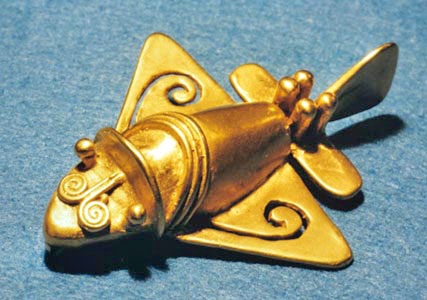
Is the concept of an airplane limited to Egypt? That doesn't seem to be the case. Gold trinkets were found in an area covering Central America and coastal areas of South America, estimated to belong to a period between 500 and 800 CE, but since they are made from gold, accurate dating is impossible and based essentially on stratigraphy which may be deceptive. However, we can safely say that these gold objects are more than 1000 years old.


Whatever this object is supposed to be or represent,
its remarkable resemblance to a modern aircraft or spacecraft is uncanny.

As seen from the pictures, the shape of the sample object is rather ambiguous. The archaeologists labelled these objects as zoomorphic, meaning, animal shaped objects. The question is, what animal do they represent? When we compare these with other objects from the same cultures depicting animals, a curious facet of the comparison would be obvious: the other objects are recognizable, rendered usually with a great accuracy and attention to realistic detail.


There are several types of animals which fly—birds, insects, and several mammals, such as bats and some gliders, for instance flying squirrels, oppossums, and then there are some lizards; there are also some fish which for brief periods glide through the air. There are water animals which seem to fly through the water, such as rays, skates and some selachians. But how does the depicted object compare with these choices? All its features taken into a consideration, we have no match. Seen from above, the object obviously has no fish features, but seems to show rather explicitly mechanistic ones.

The structures just in front of the tail are strongly reminiscent of elevons (a combination of ailerons and elevators) with a slight forward curve, but they are attached to the fuselage, rather than the wings. In any case, they look more like airplane parts than like the claspers of a fish. If the two prominent spirals on the wings are supposed to be a stylized version of the eyes of a ray, then what are the two globular objects positioned on the head supposed to represent? To complicate the identification even more, the spirals on the wings have their copies positioned on the nose of the object, in the opposite direction. When the object is viewed in profile, the didsimilarity to anything from the animal kingdom is even more pronounced. If the zoomorphic explanation is supposed to hold, then why did the artist cut the head off almost three quarters from the body? And why is the nose is practically rectangular and the cut tilted forward, with eyes positioned at either side, when fish eyes are usually more near the center of bodyline and far forward on the head?

What we can make of the semicircular grooves on the inside of the cut? What is it supposed to be—fishwise? And what about the scoop, forward and under the cut? It is a scoop, not just a ridge for drilling a hole through to place the object on a necklace chain. Then there is another rectangular feature, positioned further back at the approximate center of gravity under the fuselage. The wings when viewed from the side are perfetly horizontal, but when seen from the front, they curve slightly downward. The elevators, which are right behind the wings, are positioned on a slightly higher horizontal level and are square-ended, thus a definite geometric shape. Above them is another rectangular shape, with a relief which may be reminiscent of knobs. The tail is equally intriguing. No fish has only a single, upright and perpendicular flange. But this tail fin has an exact shape of fins on modern airplanes. There are also some markings on the tail which are hard to identify, but it does not seem to be anything related to animals, either.

When all the features are taken into an account, the object does not look like a representation of any known animal at all, but does look astonishingly like an airplane. The photos and enlarged outline of the object has been submitted for an analysis to several people from the field of aerodynamics. One of them was Arthur Young, a designer of Bell helicopters and other aircraft. His analysis confirmed that the object contains many features which would fit the airplane hypothesis, but there were several ones which would not fit that scenario. Wings do seem to be in the wrong place—they should be further forward so that their 1/4-chord coincides with the center of gravity. The nose is not like anything on airplanes, as well. So, while the object is suggesting an airplane, some features would not seem to support this hypothesis.

But let's entertain several possibilities. If we imagine that the separation after the windshield is not a cockpit and that the pilot and the cargo were located somewhere in the main fuselage body, then we can envision the nose as something else. Let's assume that the nose is actually a jet. If the machine needs to slow down, the jet flow directed against the path of flight would accomplish just that. But how to redirect the jet into the opposite direction? If we envision the nose as a movable part of the plane, turning around the point located where the nose and fuselage meet, thus pivoting the nose downward to tuck it under the fuselage, that would enable the desired effect. What's more, it will re-adjust the center of gravity and the wings would be just in the right place for a high powered flight. Another problem, though, will appear and that is the drag which would be created by the back of the nose now positioned in front. But that can be attributed to artistic license. That seems to be the case, because several other similar planes feature the back part of the nose tilted more forward, so the angle of the back of the nose when pivoted is more corresponding to aerodynamic principles.

All things considered, the object seems to represent a convertible type of craft, with two possible configurations—one for ascent when the nose is facing backwards, and the other for descent with the nose facing forward. One unsolved item remains—the spirals on the both wings and the nose. According to Amerindian iconography, these spirals have discernable meaning—they represent ascending and descending, depending on whether they are right-oriented or left-oriented, respectively. As the spirals are not only on wings but also on the nose, the meaning is fairly obvious—the wings and the nose (as much) were the features which were directly involved in ascent and descent.

There are other cultures which mention flying vehicles of some sort or another. The most known of these sources are Indian epics, especially the Mahábhárata and other Védic sources as Bhágavata Purána and Rámáyana. The flying devices were called vimánas and were extensively discussed in Vaimánika Shástra, describing multitude of machines with different purposes and capabilities.

Other source of information about flying machines may be considered, such as the Bible and some apocryphal works. The book of Ezekiel seems to be describing the close encounter of a man from a non-technological culture with a device which to him must have been miraculous. We have to put ourselves into his shoes to comprehend his astonishment and the otherworldness of his encounter. The limited scope of knowledge of the world around him, his primitive environment, dictated the language and conceptual framework with which he tried to capture his encounter for fellow tribesmen. For him it seemed that he encountered The God, with his suite of angels, because in his simple world, there was no other interpretation. It is not necessary to reach for an alien type of scenario to explain the encounter; we can entertain a possibility that a remnant of an advanced civilization was still present, in a limited scope, at the time of Ezekiel. But for some, the encounter bears uncanny similarity to the modern-day encounters with UFO's. Another source of similar material is the Book of Enoch, particularly the Slavic version, which contains some parts which the Greek version is missing. The book not only describes flying in the air, but also through outer space, including the relativistic effects mentioned—Enoch spent several days on a spacecraft, but when he returned to Earth, several centuries had passed by.

There is no shortage of descriptions of flying machines in ancient sources. If we try to extract the core of myths of different provenience and remove the embellishments, we discover to our surprise that flying in ancient times seems to be the rule, not the exception.

Wednesday, July 9, 2008

Oak Island Mystery


The Mystery Pit of Oak Island

A 19th century excavation.

One can only wonder what would have happened if young Daniel McGinnis had chosen to go exploring somewhere else on that fateful day in the summer of 1795. If he had, perhaps nobody else would have walked the woods on the eastern end of Oak Island for the next ten years. In that time, the clearing McGinnis found might have been reclaimed completely by the woods. In a forest, the thirteen foot-wide depression in the ground might never have been noticed. Thick, leafy branches might have obscured the old tackle block hanging from a branch directly over the pit. Without these markers, there would have been nothing to indicate that this was the work of man. And there might have never been the two-hundred year long treasure hunt that cost several fortunes and many lives.

More...

But McGinnis did see the clearing and the depression and the tackle block. Visions of pirate treasure did fill his head. He did return later with two friends, John Smith, age 19, and Anthony Vaughan, age 16. And together, with picks and shovels, they did start perhaps the most famous treasure hunt of modern times.

Undoubtedly, the three must have thought they were on the verge of discovering the treasure of Captain William Kidd. Stories that the captain had buried a treasure hoard on an island "east of Boston" had been circulating since the 1600's. Legend had it that a dying sailor in the New England Colonies confessed to being a part of Kidd's notorious crew, but he never named an exact location for the hidden booty.

The island McGinnis, Smith and Vaughan were on was one of 300 small isles in the Mahone Bay, Nova Scotia, Canada. It was peanut-shaped and about three-quarters of a mile long and 1,000 feet wide.

Cutting away the smaller trees, the three young men started digging in the depression. After two feet they hit a floor of carefully laid flagstones. This type of slate was not found on the island and the group figured it had been brought there from about two miles north. Below the stones they saw that they were digging down a shaft that had been refilled. The walls of the shaft were scored with the marks of pick axes, more evidence that this structure was the work of men.

At the ten foot level they hit wood. At first the group figured they'd hit a treasure chest, but quickly realized that they had found a platform of oaken logs sunk into the sides of the shaft. Pulling up the logs they discovered a two-foot depression and more of the shaft. Continuing to dig, they finally reached a depth of twenty-five feet. At that depth they decided they could not continue without more help and better planning. Covering the pit over, they left. One thing the three were sure of, though, was that something must be at the bottom of the pit. They concluded that nobody would have gone to the trouble of digging a shaft deeper than 25 feet unless he had something very valuable to hide.

Nineteenth Century Excavations

Not much more was done with the pit until around 1802. While stories differ, it seems likely that the three spent the previous years searching for a financial backer to provide assistance for a more sophisticated dig. Simeon Lynds visited the money pit that year, was impressed by the story, and formed a company to support the excavation.

The work was started in the summer of 1803. After cleaning out the old pit, the crew started digging downward. Stories have it that they struck another oak platform at 30 feet below the surface. As they continued to dig they found something every ten feet: charcoal, putty, stones or more log platforms. Finally, at the 80 or 90 foot level, depending on which historical account you read, a flat stone, three feet long and one foot wide, with strange letters and figures cut into it, was found. At 93 feet deep, the floor of the pit began to turn into soft mud. Before the end of that day the crew probed the bottom of the shaft with a crowbar hoping to find something. They hit a barrier as wide and as long as the shaft. The group speculated that they'd finally reached the treasure vault and went to bed with the expectations that tomorrow a fortune would be theirs.

Returning the next day, the crew was shocked to find that overnight the pit had filled with 60 feet of water. Bailing was useless. As soon as water was removed from the pit, more flowed in to take its place. An attempt was made to dig another shaft nearby and get at the treasure by running a tunnel underneath the pit, but the new shaft flooded as soon as the tunnel got close to its objective.

Another attempt to find the treasure wasn't made until 1849. A new corporation was formed to finance the dig. This group wasn't much more successful, running into the same flooding problems that occurred back in 1802. They did manage to use a drill to probe what was below the money pit floor. A platform was constructed in the shaft just above the water level and the drill operated from there. The drill seemed to bore through levels of oak, spruce and clay. One sample recovered what appeared to be several links of chain made of gold.

While the drilling was going on, someone noticed that the water in the pit was salty and rose and fell with the tide. This led to speculation that the builders of the pit had conceived a clever trap designed to flood the pit with water if someone got to close too the treasure.

The existence of the flood trap was confirmed by the discovery that the beach of Smith's Cove, located some 500 feet away from the money pit, was artificial. Examination showed that the original clay of the cove had been dug away and in its place laid round beach stones, covered by four or five inches of dead eel grass, which was covered by coconut fiber two inches thick and finally the sand of the beach. At the bottom of all this were five box drains that apparently merged somewhere well back from the coast into a single tunnel that ran the distance to the money pit. The system was apparently designed so that the filtering action of the coconut fiber and the eel grass would ensure the drains would never be clogged by sand or gravel from the beach. It worked well.

Attempts were made to put the flood trap out of business by building a cofferdam around the cove to by holding the tides back. Later, pits were dug to intersect and plug the tunnel on its route to the money pit. These failed, and this try at reaching the treasure was given up in 1851 when the money ran out.

The next attempt in 1861 cost the first human life. The searchers tried to pump out the money pit using the steam engine-powered pumps. A boiler burst and one worker was scalded to death while others were injured. Further fatalities were barely avoided when the money pit's bottom, weakened by attempts to get at the treasure by digging up underneath from other shafts, collapsed. If there were any treasure chests they were probably carried much deeper by this crash. This dig did succeed in discovering where the flood tunnel entered the money pit, but there was still no way to turn off the water. By 1864 these searchers were also out of money.

In 1866, 1893, 1909, 1931 and 1936 additional excavations were started. Extreme methods were used including setting dynamite charges to destroy the flood tunnel, building a dam to keep the water out of Smith's Cove, and bringing in a crane with an excavation bucket. None of these approaches recovered a single coin while costing the backers a small fortune and one worker his life. One of these efforts did manage to block off the flood tunnel from Smith's Cove, only to discover more water was pouring in from the opposite direction via a natural or man-made route from the south shore. Drilling also indicated that there might be some kind of cement vault at the 153-foot level. By this time the south end of the island was full of old shafts, though, and it was increasingly hard to tell were the original money pit was located. Searchers often ran out of money just trying to figure out where the old shaft had been.

Modern Excavations

In 1959 Robert Restall, a former daredevil motorcyclist, took up the challenge with the help of his 18-year-old son. By then the Smith Cove's flood tunnel had become unblocked and Restall made it his first order of business to seal it off. He had sunk a shaft to the depth of 27 feet near Smith's Cove when tragedy struck. His son found him laying at the bottom of the pit in muddy water. Climbing down to help his father, the boy suddenly fell off the ladder and lay next to him. Kal Graseser, Restall's partner, and workers Cyril Hiltz and Andy DeMont climbed down to assist, but also collapsed before reaching the bottom. Edward White, a visiting fireman from Buffalo, New York, immediately suspected carbon monoxide poisoning from the exhaust of a nearby gasoline pump and descended the pit with a rope tied around his waist. He was able to rescue DeMont, but the others died. In one day Oak Island mystery claimed four more lives.

In 1965 Robert Dunfield tried to apply modern open pit mining methods to the treasure hunt. Using a 70-ton digging crane he dug a hole at the original pit site 140 feet deep and 100 feet in diameter. The dirt was carefully sifted for any treasure, but only a few pieces of porcelain dishware were found. Heavy rains dragged the work out for months and Dunfield ran out of money. The pit, and its mystery designer, had won again.


The Money Pit today. (Courtesy of Bill Milstead)

In 1970 the Triton Alliance was formed to continue looking for the treasure. Legal battles between owners of different portions of the island resulted in slow progress. A number of holes were drilled in an attempt to locate the treasure and better understand the geological nature of the island, but no gold was recovered. Little work has been done in the area of the money pit itself as the soil is unstable. Often caverns, thought to be natural, have been found beneath the island. A video camera lowered down one borehole into one of these spaces recorded an image that looked like chests and a human hand severed at the wrist. The quality of the images was so poor, though, that positive identification was impossible.

Triton brought the Woods Hole Oceanographic Institute in to survey the island in 1995 and render an opinion on whether there is something valuable at the bottom of the pit. While their report is confidential, people who have seen it say that its conclusions are "not discouraging." Currently little work is being done on the island while disputes between the owners of Triton are being settled.

In addition to the money pit the rest of the island seems to be loaded with old stone markers of various types. The most peculiar of these are 6 boulders that seem to be laid out in the shape of a cross that is almost 900 feet long. Some wild speculation based on the cross suggest that Oak Island might be home to the long missing Holy Grail, but there is no real solid evidence to support this idea.

Possible Culprits

So, who built the money pit? And did they really put some kind of treasure down there? Was it Captain Kidd? Despite the legends it seem unlikely that Captain William Kidd ever had the chance to bury a treasure on Oak Island. He spent little time near Nova Scotia and certainly not enough to construct the money pit. Kidd did bury a cache of booty on Gardener's Island near the eastern end of Long Island Sound, but it was quickly seized by the Governor of New York.

Blackbeard, who possessed perhaps the most notorious reputation of all pirates, has sometimes been mentioned in conjunction with Oak Island, but only because he once boasted he had an underground cache for his treasure, "where none but Satan and myself can find it." Certainly many of the Oak Island treasure hunters would agree that this sounds like the money pit, but the truth is there isn't any evidence that Blackbeard conducted any operations north of Delaware.

In fact, it seems very unlikely that any pirate could be responsible for such a complex labyrinth as the pit. Pirates buried treasure because it offered a quick way to hide and recover their goods. A digging operation that must have taken several months just doesn't seem their style.

George Bates, a land surveyor in Nova Scotia, suggested that pirates had indeed built structures on Oak Island, but not for the purpose of hiding treasure. Bate's idea was that there was enough pirate activity between 1650 and 1750 off the coast of Nova Scotia to warrant several pirate groups getting together and building a dry dock to maintain their ships. To do this they sailed their vessels into Smith's Cove and built a cofferdam to seal the tiny bay off from the ocean. The flood tunnel was used to then drain the cove and leave the ship high and dry. The water flooded down the tunnel into a large natural cave underneath the island. A windmill located on top of the money pit extracted the water so the cove could again be drained for the next ship.

The weakness of Bates argument is that located on the other side of Nova Scotia, only a hundred miles away, is the Bay of Fundy. The tides in the bay drop at least 30 feet each day making it a huge natural dry dock. Why would the pirates duplicate what nature already provided?

Speaking of nature, is it possible that the money pit is a natural phenomena, not a cleverly designed vault? Certainly there are natural caves under Oak Island and the depression found by McGinnis could have been a sink hole. Unless all early accounts are completely incorrect the descriptions of the platforms carefully placed at 10-foot intervals seem to ensure that at least part of the structure is man-made.

Some theories suggest that the structures built on Oak Island may have been hundreds, perhaps even thousand of years old when they were discovered in 1795. They may have been built by Vikings visiting the New World, or by the native Micmac people who lived in the region before the Europeans appeared. Perhaps they were built by an advanced civilization that we know nothing about. Indeed the flood tunnel trap built into the pit in some ways reminds one of the false doors and granite plugs found in Egyptian tombs to prevent grave robbing.

If any of the above theories were true why did McGinnis discover the pit in the heart of a clearing? The trees around the money pit must have been cut when it was constructed. Given the rate oak trees grow, that meant someone had built the pit not more than fifty years before McGinnis stumbled across it.

Who would have hidden a treasure between 1745 and 1795? William Crooker, author of several books on the Oak Island mystery, suggests that the pit was built as a part of plot by King George III of England and several of his close advisors. On August 12, 1762, British forces captured the city of Havana, Cuba, from the Spanish. Havana was a rich, important city where much of the gold from the New World was shipped back to Spain. Two shiploads of the captured booty, Crooker suggests, was taken by the Earl of Albemarle to Oak Island. Previously the conspirators had arranged for military engineers to come to the island and build what they thought was a secret ammo dump complete with flood tunnels. Albemarle arrived with the treasure in sealed boxes. The treasure was placed in the pit, the pit was closed, and the engineers departed still thinking they had built an ammo dump.

Albemarle returned to England with the idea of retrieving the treasure later. Something, perhaps the madness that afflicted King George toward the end of his life, prevented getting the booty and it was forgotten about.

Crooker's theory raises another possibility, though. Suppose there is no treasure at all and the pit is simply an old ammo dump? We will only find out for sure when someone comes along who is clever enough, and rich enough, to beat the designer of the money pit and make a thorough investigation of what lies at the bottom.